Salesforce Integration Playbook
.avif)
.avif)
.avif)
What's inside
- Clean data wins
- Let's get your house in order
- What the integration does, at a glance
- The clean contact record
- The clean company record
- The clean team record
- Update rules built at the field level
- The data you cannot get in a standard CRM
- Dynamic Lists that work for you
- Act on it: marketing and outreach in Salesforce
- Built for how your team sells
- Getting started
Clean data wins
Most CRMs in wealth management run on data that decays fast and takes manual effort to refresh. Firm and rep records get entered once and rarely touched again, AUM figures and rep moves fall quarters behind, and the signals that actually drive deals, a firm hire, an allocation change, a registration change, usually never make it into Salesforce at all.
The AdvizorPro integration closes that gap. We start by getting your records clean, structured, and current, then our integration keeps feeding fresh advisor and firm intelligence directly into Salesforce from there. No exports, no manual lookups, no data wrangling on your end.
This playbook covers what populates on your records, the data points you cannot source anywhere else, the auto-generated lists that surface opportunities, and how to turn that intelligence into outreach that books meetings.
Griffin Capital faced this exact problem before partnering with AdvizorPro. See how they automated their CRM workflow with AdvizorPro to build a smarter, more confident distribution team.
Getting your house in order first
Before anything gets automated, we clean up what's already in Salesforce. Our integration specialist team guides this work as part of onboarding:
- Map CRDs: Tie every record to a verified CRD, even if you're starting from little or none.
- Identify duplicates: Flag and reconcile duplicate records so reps aren't chasing two versions of the same firm or advisor.
- Update stale records: Refresh outdated contact info, expired registrations, and advisors who've retired or moved on.
- Enrich what's there: Fill in the context standard records lack, tech stack detection for wealthtechs, platform and investment theme signals for asset managers, and more.
What the integration actually does
- It fills your records in for you. Accounts and Contacts populate automatically with AdvizorPro firm, team, and advisor data.
- It keeps up on its own. AUM, headcount, registrations, tech stack, advisor moves, all of it stays current on our update schedule. Nothing to maintain by hand.
- It goes past the basics. You get fields a normal CRM has nowhere to put, from ETF holdings to SMA breakdowns to the exact date an advisor broke away.
- It does something with the data. It feeds Salesforce Dynamic Lists and Flows, so a lot of the prospecting ends up running itself.
The clean contact record
Every advisor record shows up already filled in. Who they are, how they are registered, their designations, how long they have been at it, and how to reach them, all sitting right next to the standard Salesforce fields your reps already use.
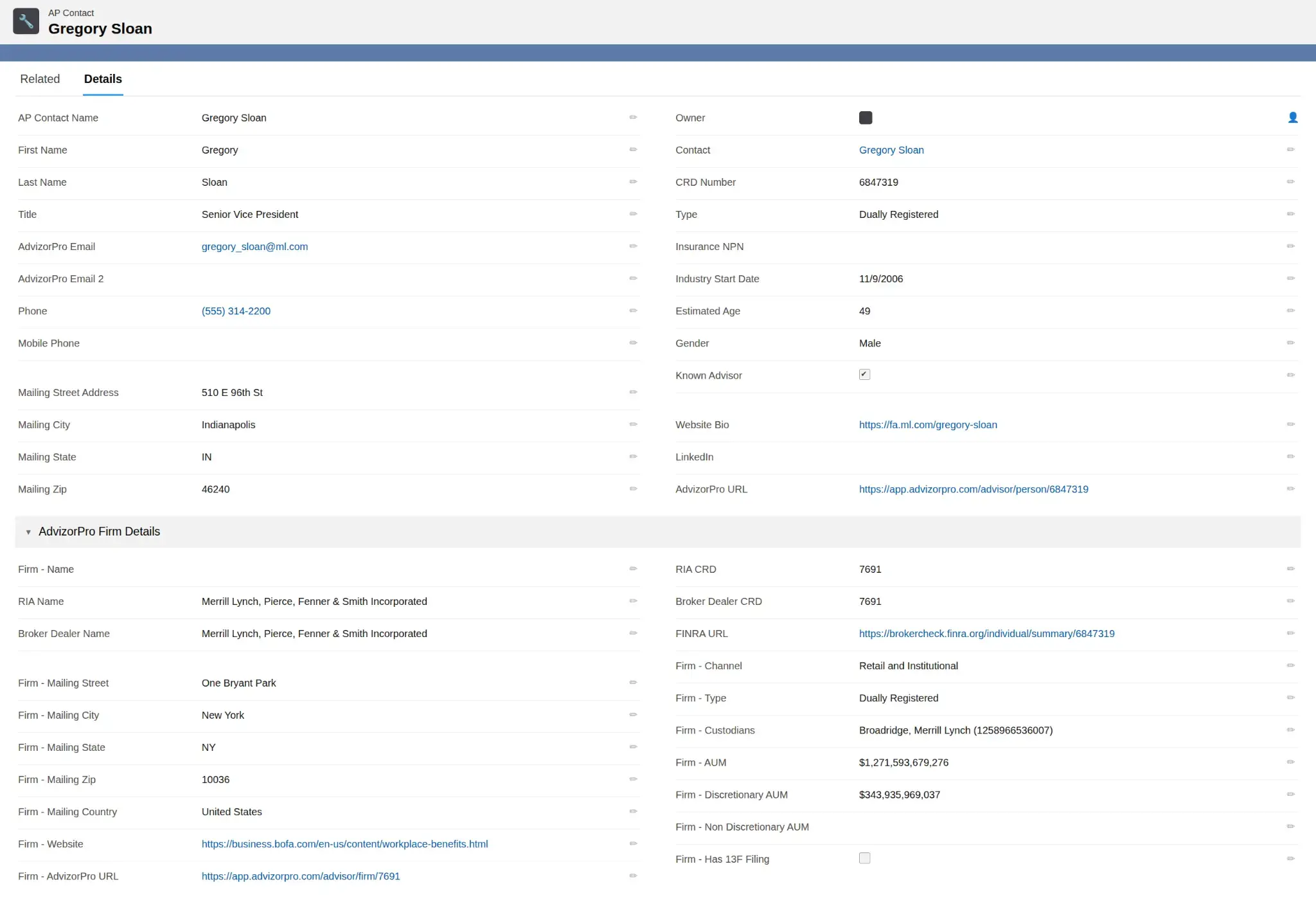
Contact record with the AdvizorPro tab. All identifying details are anonymized for this guide.
- Advisor Details. RIA, B-D, or dual, their registration status, title, designations and licenses, plus links straight to their AdvizorPro, FINRA, and SEC pages.
- Firm Registration. Their current RIA and broker-dealer with CRDs, how much experience they have, and how long they have been at each firm.
- Firm Registration History. Where they were before, the prior CRDs, and the exact date they switched. That last one is the backbone of every advisor moves play later on.
The clean company record
Firm records come pre-loaded with the numbers you would normally go hunting for across numerous sources. And it all lives in one place. Firm info, AUM, growth, tech stack, and tags on a single AdvizorPro tab, so nobody is bouncing between five screens just to size up who they are dealing with.
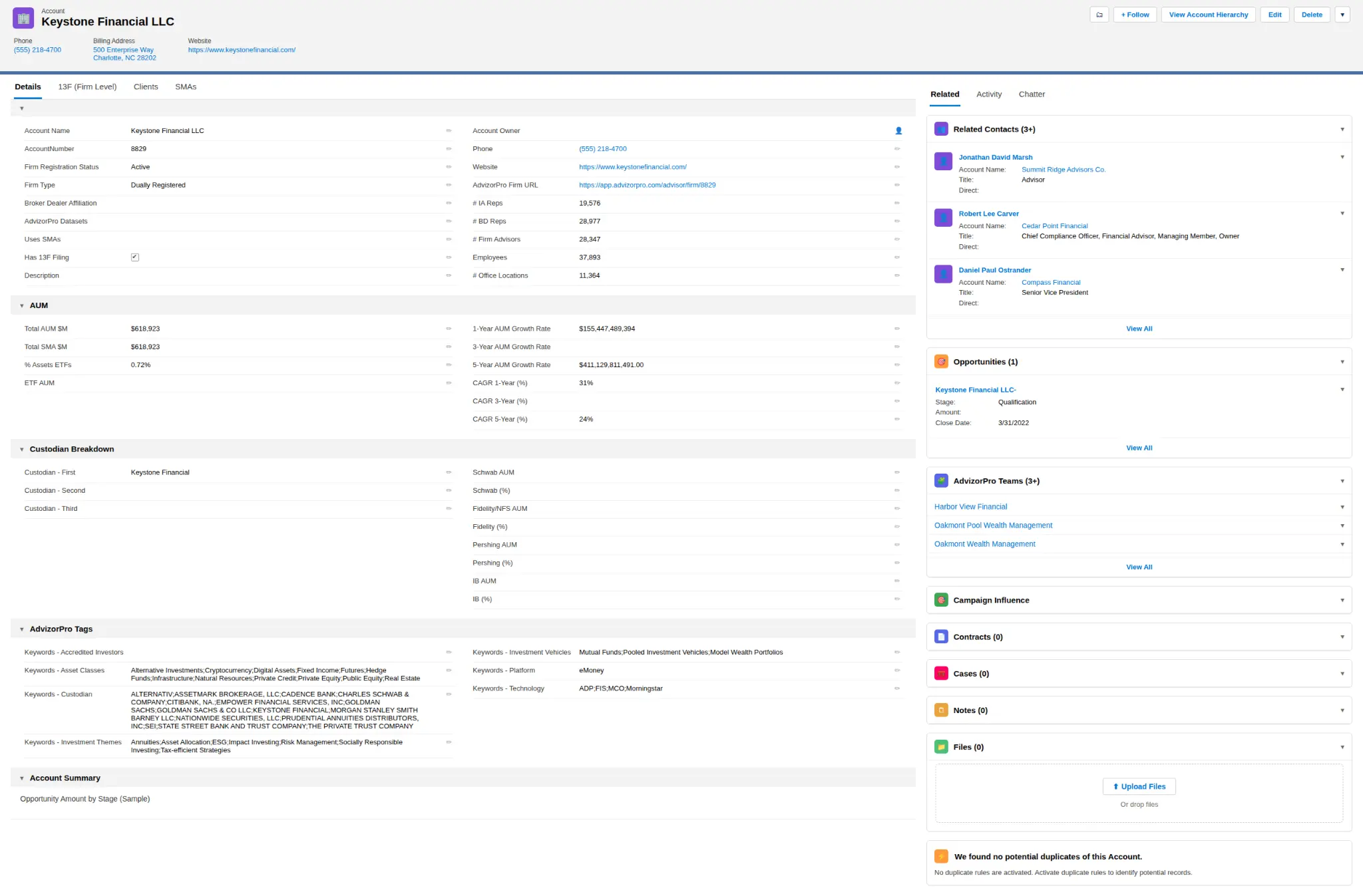
Company record with the AdvizorPro tab. All identifying details are anonymized for this guide.
- Firm Info. CRD, firm type, registration status, custodians, BD affiliation, employee and rep counts, and how much of the book sits in ETFs.
- AUM. Total and average AUM, account counts, average account size, and the full discretionary versus non discretionary split.
- Growth. AUM growth over one, three, and five years, in dollars and percent, with CAGR and a plain read on what is happening.
- Tags. Custodian, client persona, and investment vehicle keywords you can filter and target on right away.
The clean team record
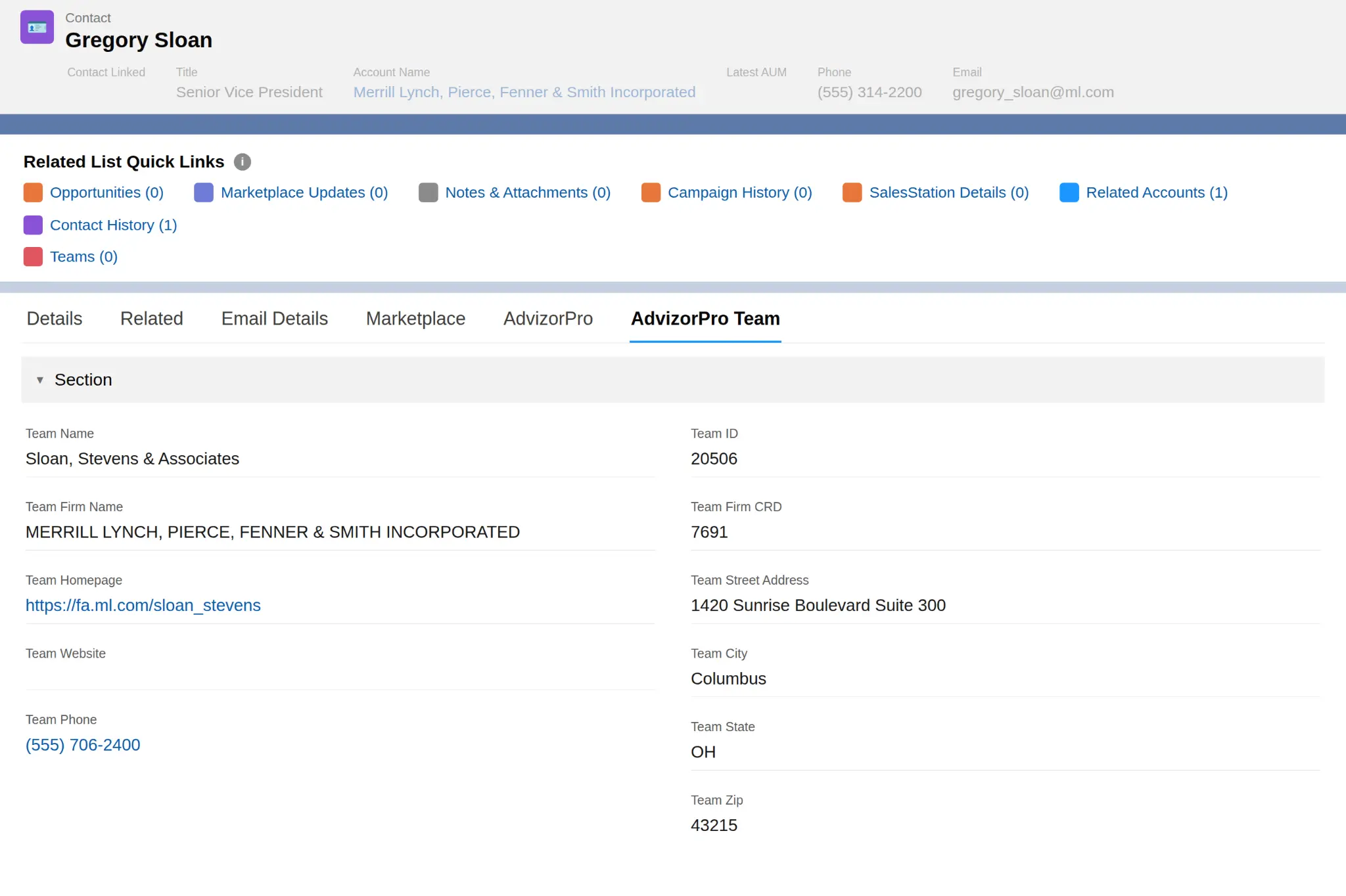
In wealth management, the standard CRM hierarchy falls apart fast. A wirehouse is not really one firm. It is hundreds of branches and teams, and your rep needs to know which one they actually have on the phone.
So we build the real structure underneath it. Parent-child hierarchy in Salesforce, and on top of that, team, and fully custom objects.
Take Scott A'Hearn, a Merrill advisor at 510 E 96th St in Indianapolis. His parent company is Merrill, the branch he is attached to has 108 advisors, and three of them, Scott included, make up the "A'Hearn Stevens & Associates" team, which we track as its own custom object. That team is a Forbes 2026 Best-In-State Wealth Management Team running $444M, and Scott himself is on the Forbes 2026 Best-In-State Wealth Advisor list.
It cuts the other way too. The Bahnsen Group at Hightower runs $4.4B across 43 advisors, based in Newport Beach with offices in nine other states. Because the custom object shows who reports up to that California team, a rep covering Florida knows to leave the Florida-based Bahnsen advisors alone. They belong to the California owner.
That is the difference between a CRM that just holds firm names and one that actually knows who owns which relationship.
Update rules built at the field level
Most integrations make you pick one update setting and use it on everything. We let you decide field by field.
Say Robert goes by Bob. You would probably set that to update only if the field is empty, so a rep's manual fix does not get wiped out on the next sync. But if his email flips from an lpl.com address to his new firm's domain, you want that to overwrite, no question about it. Different fields, different rules.
We can do this because we built the integration ourselves instead of leaning on a third-party sync tool, which is the route most competitors take. One of them, for example, splits CRD data across three separate fields, "CRD," "competitor CRD," and "competitor ID." That adds confusion, not clarity.
We also handle your territory setup up front, so leads land with the right owner from day one and stay there as records change. And all of it gets tested in a sandbox before it goes anywhere near your live CRM.
The data you cannot get in a standard CRM
This is where reps stop guessing. Past the basics, we can bring in intelligence a generic CRM simply has no field for.
One note: what actually shows up depends on which AdvizorPro datasets you are on, so treat the list below as what is possible, not a fixed menu. And if you have your own data pack, we can map that into the firm records too, right alongside the AdvizorPro fields.
13F holdings
For RIAs that file 13Fs, we pull their reported positions and firm level holdings into Salesforce. If you are an asset manager, you can see who already owns something like your strategy and pitch accordingly.
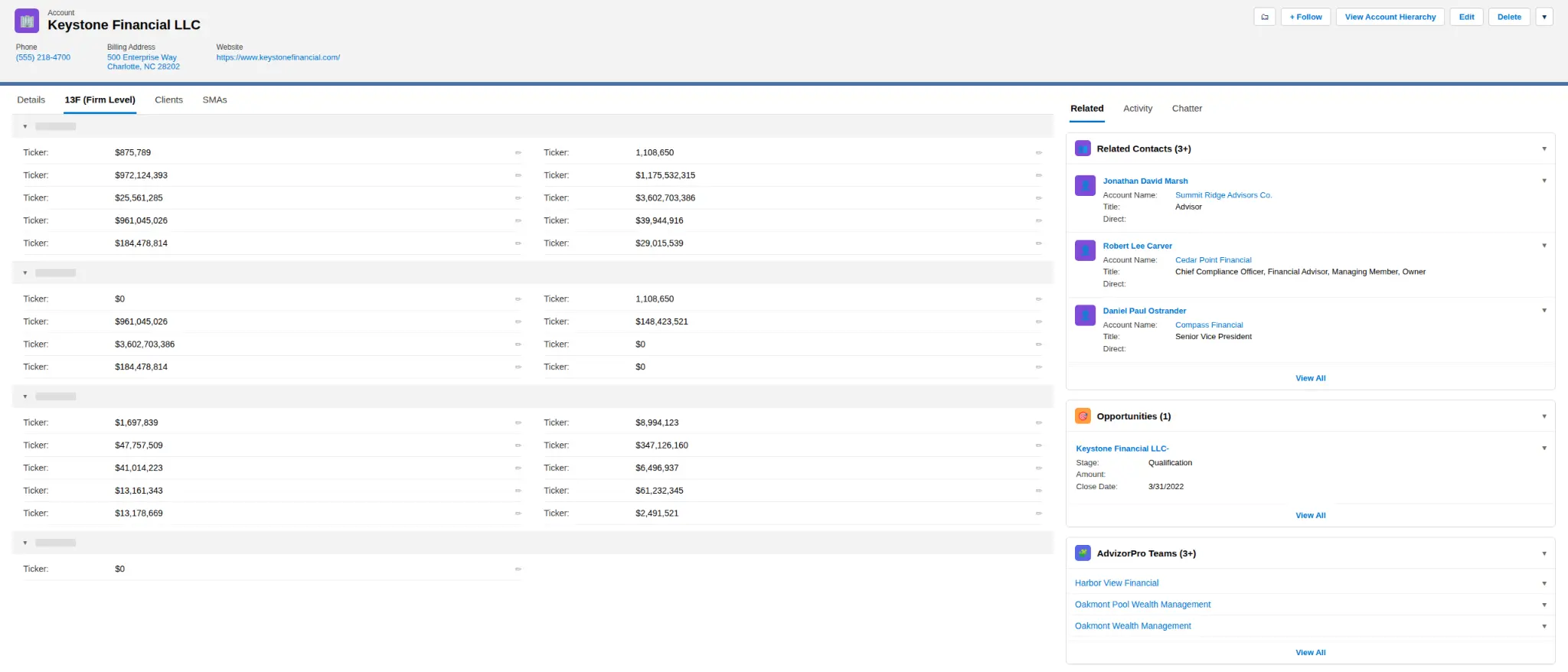
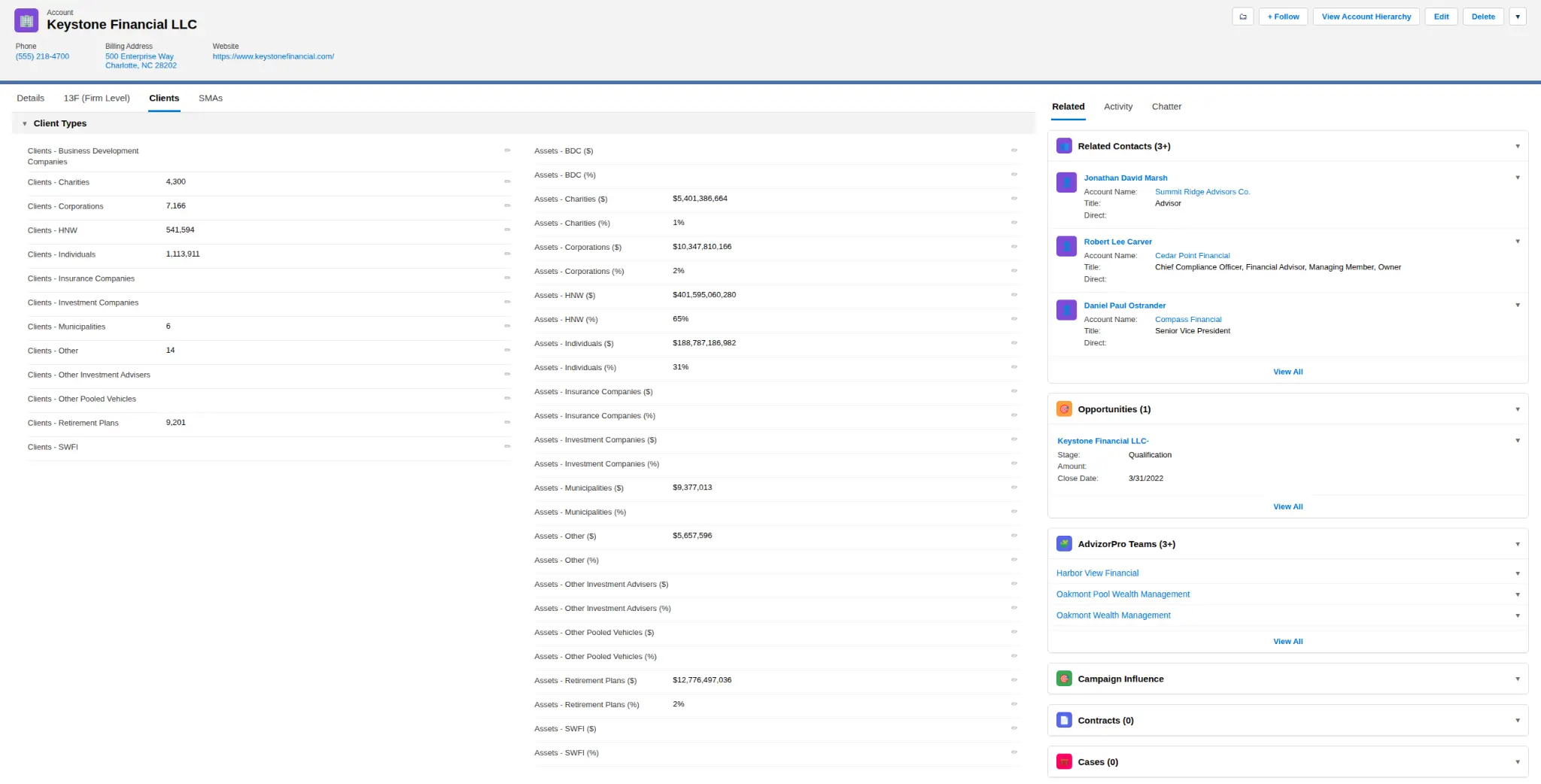
Client types and asset breakdown
Counts and dollars by client segment, so high net worth, individuals, retirement plans, charities, corporations. You get a feel for who a firm really serves before you ever pick up the phone.
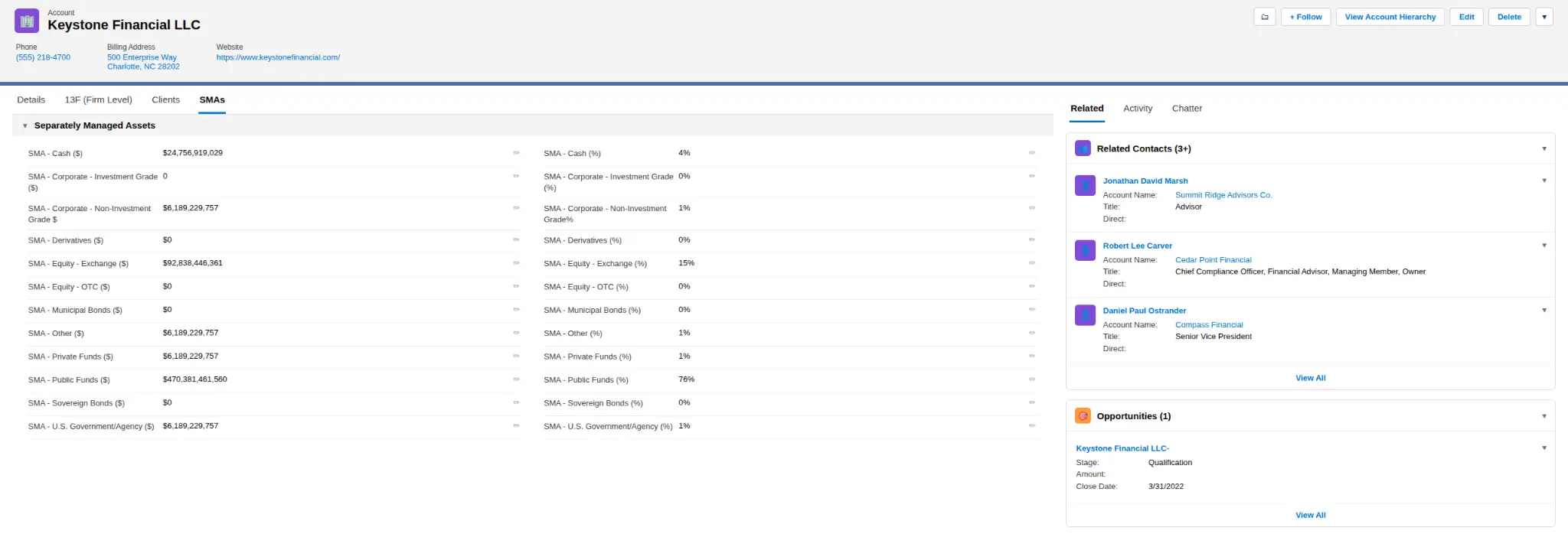
SMA composition
Separately managed account assets split out by sleeve, from equities and public funds to corporate credit and cash. A distribution team can match product to mandate without much digging.
Plus everything around it
Custodian breakdown, family office flags, and the keyword tags that make precise segmentation possible, all on the same record.
Note: the exact fields shown depend on your AdvizorPro datasets, and licensed data packs can be mapped into firm profiles too.
Dynamic Lists that do the work for you
Dynamic Lists are the real engine here. Because we keep the underlying fields current, a list you set up once just keeps refreshing itself, adding advisors the moment they fit what you asked for. The three below are examples, not the whole menu. You can build a list off any AdvizorPro field.
Advisor Moves
Nobody is warmer than an advisor who just changed firms. Right now they are rethinking their tools, their custodian, their partners. This list watches the firm change date and pulls up everyone who moved recently, with their old firm and new firm side by side.
Use it for timely congratulations outreach, a tools or onboarding pitch, or a custodian conversation.
Team Moves
Sometimes it is not one advisor, it is a whole team walking out the door. Wirehouses run on hundreds of DBAs, and we track the individual teams sitting underneath them, so what looks like one giant firm breaks apart into the real practices and people. Team Moves clusters advisors who share an old firm and a recent move, so you can spot the breakaways and go straight to whoever is calling the shots.
Use it for recruiting plays and high value, team level outreach.
Breakaway Advisors
Advisors leaving a wirehouse or a big broker dealer to go independent are exactly who custodians, platforms, and wealthtechs want to talk to. This one keys off the breakaway signal and shows the prior firm, the new RIA, title, and experience.
Use it for recruiting, platform and custody pitches, and product distribution.
Recent Website Visitors (TrafficIQ)
A warm lead beats a cold one every time. TrafficIQ tells you which firms have been on your site, even the ones that never filled out a form, and drops that into Salesforce. This list shows who has been poking around lately, so you can reach out while you are still on their mind.
Use it for warm outreach to firms already researching you, retargeting, and prioritizing the day's call list.
Build your own
Find the AdvizorPro field that signals intent or fit, set your condition, save it as a Dynamic List, and let the pipeline fill up. A few to start with:
- Firms over a certain AUM in a metro you care about.
- Firms on a specific custodian, or running something like Addepar, Orion, or Black Diamond.
- Anything flagged as a family office.
- Advisors with a certain designation, or a minimum number of years in the business.
Act on it: marketing and outreach in Salesforce
Clean data and smart lists only matter if you act. This integration is one layer of a bigger picture: see the GTM stack we see behind the fastest-growing advisor distribution teams for where it fits. Here is how to turn AdvizorPro records into pipeline inside Salesforce.
Segment first
Start by slicing your records into audiences that deserve different messages.
- By AUM tier: Route the largest firms to senior reps and tailor the offer.
- By custodian: Lead with the integrations and workflows that fit their platform.
- By tech stack tag: Speak to the tools they already run, such as Addepar, Orion, or Black Diamond.
- By client persona or family office flag: Match your message to who the firm actually serves.
- By firm type or registration: Separate independent RIAs from dually registered and wirehouse advisors.
- By metro or AUM growth: Focus on the fast growing firms in a target region.
Email campaigns
Create lists and trigger email campaigns. Each one pairs a trigger with a message that fits the moment. Here is roughly what an Advisor Moves welcome flow looks like once you build it out.
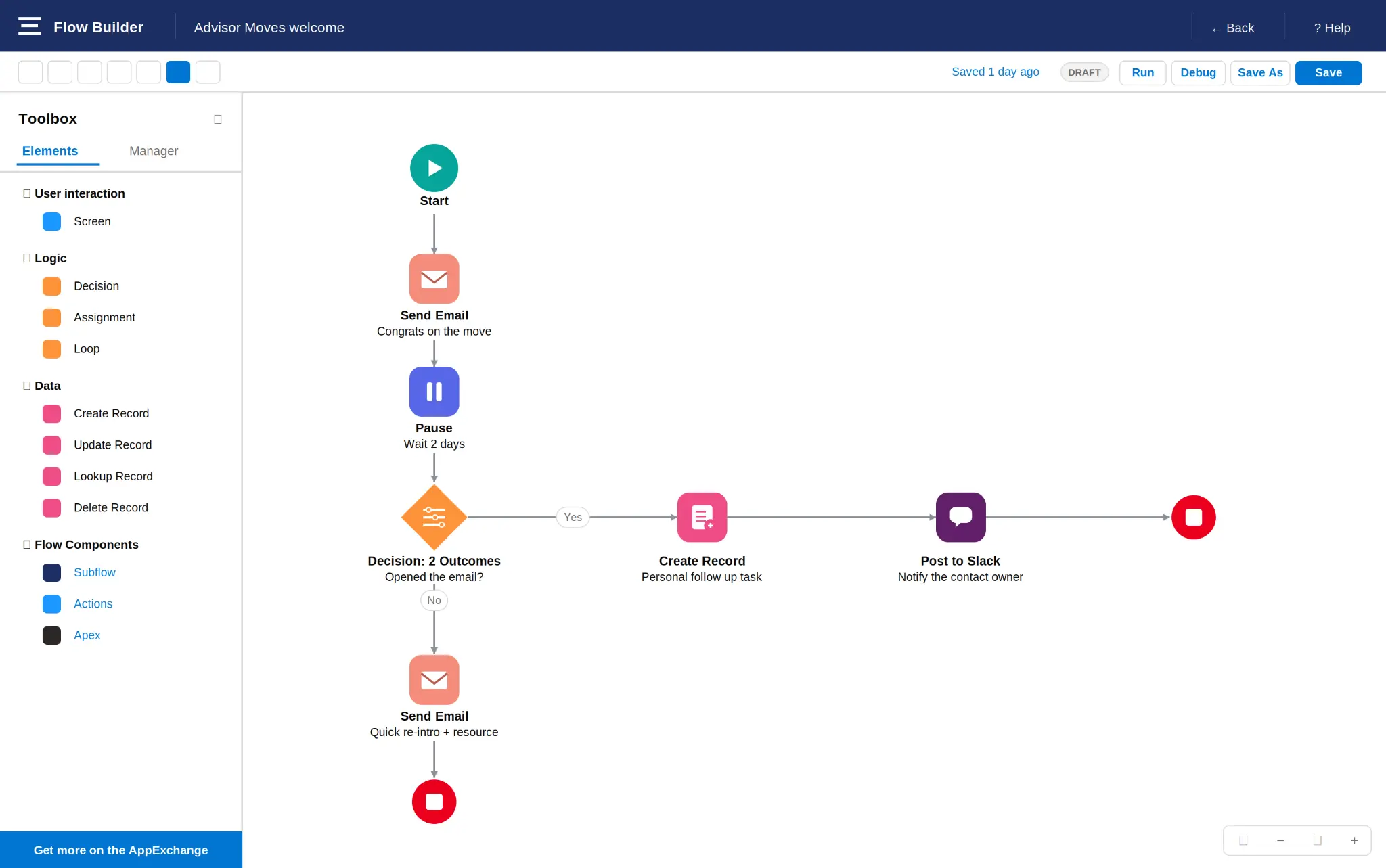
An Advisor Moves welcome workflow: enroll from the list, send a note, wait, then branch on engagement.
Triggered workflows
These fire on their own the moment a record changes. A few worth standing up first:
Built for how your team sells
The integration pays off differently depending on what you sell. Here is where each team gets the most leverage, and the AdvizorPro data and lists that power it.
Asset Managers
Work out which firms already lean toward your kind of strategy before you reach out, then tailor the pitch.
- 13F holdings. Spot firms already holding something like your strategy, or a competitor's, and pitch a swap or an add-on.
- SMA composition. Go after firms whose mandates line up with your sleeve, say heavy public equity or corporate credit.
- Client types. Match your product to the book they actually run, whether that is high net worth, retirement plans, or institutions.
- AUM and discretionary assets. Point your wholesalers at the firms big enough to move the needle.
- Flow data by branch. If you have a data pack, see how much AUM a firm like LPL holds with you, broken out by branch, then down to the teams and advisors inside each one.
ETF Distributors
Find the firms most likely to buy ETFs and say the right thing.
- ETF exposure. Build a list of firms already heavy in ETFs and nurture them by theme.
- Custodian and platform tags. Shape your availability and trading pitch around the platform they use.
- Investment vehicle tags. Catch firms drifting from mutual funds and models toward ETFs.
- AUM growth and CAGR. Get to the fast-growers before your competitors do.
Wealthtechs
Find firms on a competing or nearby tool and time your outreach to when they are most likely to switch.
- Tech stack tags. Target whoever is on a competitor's tool, or one that pairs well with yours.
- Advisor Moves and Breakaway lists. Catch advisors mid-transition, when they are most open to trying something new.
- TrafficIQ. Reach the firms already looking you up.
- Firm size and rep count. Size up the account so your plan and onboarding fit.
Recruiters
Catch movement and lift-out opportunities as they happen, with enough context to qualify fast.
- Advisor Moves and Team Moves. See advisors and whole teams on the move, right down to the teams buried inside wirehouse DBAs.
- Breakaway list. Find advisors going independent, with the prior firm, new RIA, title, and experience already attached.
- Production, designations, tenure. Qualify someone before you spend a call on them.
- Registration history and change dates. Time your outreach around the move itself.
Getting started
There is almost nothing on your end. You get a dedicated AdvizorPro integration specialist, someone who has done this for hundreds of firms, and they handle the cleanup, the hierarchy, the field-level rules, and the mapping. All of it gets tested in a sandbox before it goes live.
And it does not stop once you are set up. It is an ongoing service that comes with your subscription, so your specialist keeps tuning things as your needs change. Once it is running, your team builds a Dynamic List, hangs a workflow off it, and watches the pipeline start to fill. Want to get going, or change the datasets for your team? Just talk to your AdvizorPro contact.
About AdvizorPro
AdvizorPro is the advisor intelligence platform built for asset managers, ETF issuers, wealthtechs, and distribution teams that need to identify, prioritize, and engage financial advisors. With verified data across 750,000+ RIAs, family offices, and broker-dealers, combined with AI-powered lead scoring, TrafficIQ visitor intelligence, native CRM integrations, and now direct connectivity to Claude and ChatGPT, AdvizorPro powers the go-to-market strategies of leading firms across the wealth management ecosystem.

Cole Cummings is the Director of Marketing at AdvizorPro and a B2B SaaS marketer with multiple years of experience in the fintech industry. He leads all of AdvizorPro’s data-driven research and industry reports, giving him deep expertise in the RIA ecosystem and the trends shaping advisor behavior, allocation decisions, and firm growth across wealth management.
Related Post
Related insights you may find valuable