How Private Placement Sponsors Can Use Form D Data to Raise More Capital
.avif)
.avif)
.avif)
Every private placement sponsor faces a similar distribution problem. You know your product is good, but getting it in front of the right broker-dealers and reps takes years of relationship building, conference circuits, and cold outreach to firms that may never sell alternatives.
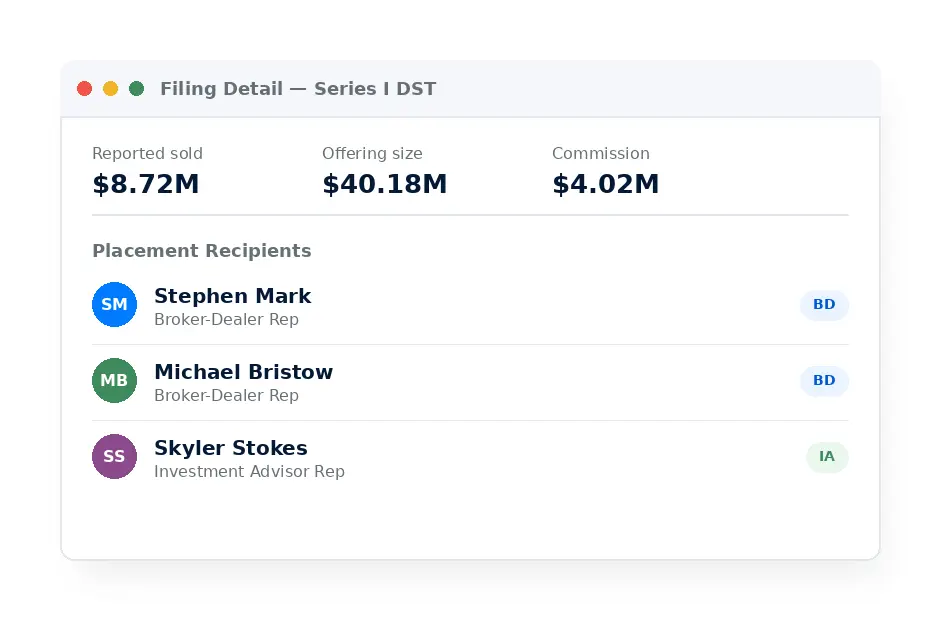
Much of the information that shortens that process sits in Form D filings, and AdvizorPro now includes Form D data through Private Placement Intelligence. When a DST, opportunity zone fund, or private credit offering is sold through broker-dealers, the issuer files a Form D with the SEC listing who received sales compensation. Those filings show which BDs are selling private placements, which reps are placing them, and how much capital is moving. The challenge has been that the filings are scattered, inconsistent, and disconnected from the contact data and deeper rep intelligence you need to act on them.
AdvizorPro is built to solve that. Our data engine collects filings, registrations, firm disclosures, and public records from numerous sources, then structures, cleans, and maps them using a combination of AI and a dedicated data team. Form D and D/A filings are matched to the right broker-dealers and reps, even when names are misspelled, firms have changed names, or reps have moved between BDs. That's how a rep named on a DST filing links to a verified profile among more than 750,000 RIA and broker-dealer professionals, complete with contact data, AUM, client profiles, and career history.
What the data shows
Each broker-dealer profile includes a Private Offerings tab built from Form D filings. Here's what you'll find there.
Recent offering changes. A feed of the latest amendments to offerings the BD is selling, with the new dollars reported sold since the prior filing. This shows what a firm is actively raising money for right now, not just what it sold two years ago.
Co-placement network. The other broker-dealers that most often appear on the same offerings, with a count of shared deals. BDs that repeatedly show up together have usually cleared due diligence on the same sponsors, which makes this one of the best signals of where your next selling agreement is likely to come from.
Offering track record. The BD's full history as a selling dealer: each offering, its asset type, its filing history, and the amount reported sold.
Filing history detail. Expand any offering to see its first sale date, minimum investment, investors reported, solicitation states, offering size, commissions, and how each amendment changed the picture.
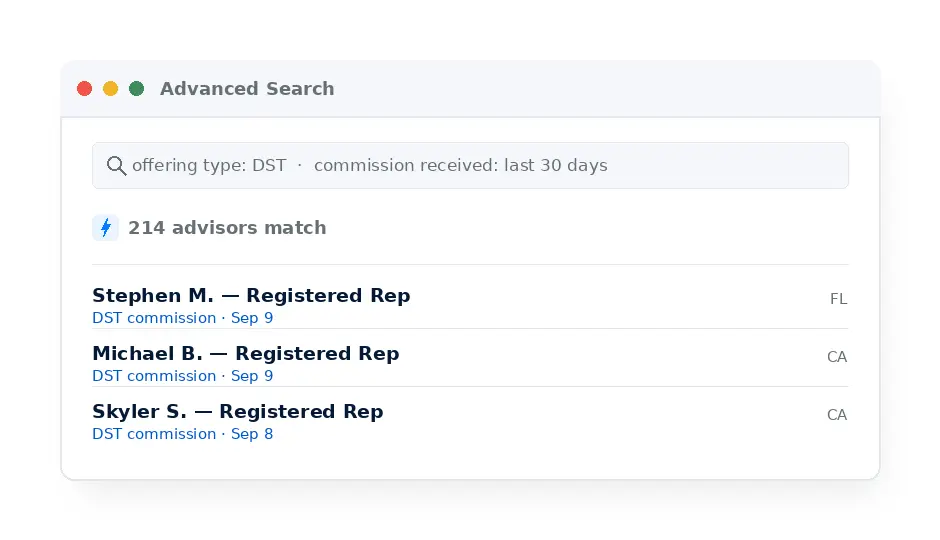
Placement recipients. The individual reps named on each filing, with badges showing whether they're registered as investment adviser representatives or BD reps. Each name links to a full profile with contact information, AUM, custodian, team structure, career history, and more.
Five ways to use it
1. Map your competitors' distribution. Search for offerings in your category and see which broker-dealers are selling them. If a competing DST sponsor has 30 BDs in its selling group and you have 12, the 18 you're missing are your target list. They already sell your product type, their due diligence teams understand the structure, and their reps have clients who buy it.
2. Prioritize selling agreements using the co-placement network. Start with a BD that already sells your offerings and look at its co-placement network. The firms that sell alongside it most often are the ones most likely to approve you next, because they tend to vet the same sponsors. This turns a list of hundreds of BDs into a short list of firms with a real reason to say yes.
3. Target reps, not just firms. A selling agreement is only the start. Capital comes from individual reps choosing your offering over the others on their firm's shelf. Placement recipients show you which reps at an approved BD are actually placing private deals. Your wholesalers can focus on those reps instead of working through a full branch list, and they can walk into the conversation knowing what that rep has sold before.
4. Time your outreach. Recent offering changes show when a BD is actively placing capital. A rep who just placed a new DST likely has 1031 clients moving through the pipeline and is thinking about what comes next. Filing cadence also helps you spot when a competing offering is nearing its full raise, which often means reps will be looking for a replacement.
5. Plan territories with solicitation states. Each offering lists the states where it's been marketed. Use this to see where demand for your product type is concentrated, where competitors are active, and where you have gaps in coverage.
Getting the most out of it
A few practices we see from sponsors who get the most value:
- Build lists from the data, then work them in your CRM. Push BDs and reps directly into HubSpot or your CRM so wholesalers work from one system.Our guide on how to integrate RIA and broker-dealer data with HubSpot walks through the setup.
- Combine Form D signals with advisor data. A rep who places private deals, runs a team with $500 million in AUM, and custodies at Pershing is a different conversation than a solo rep with one DST on record. Use AUM, team size, and custodian to prioritize. Our guide to turning custodian and broker-dealer data into actionable intelligence covers how to layer those signals together.
- Check your own profile. Look up the BDs selling your offerings to confirm your filings are being captured the way you expect, and to see which of your selling-group partners also sell your competitors.
- Refresh regularly. Amendments come in constantly. The BDs and reps active this quarter won't be identical to last quarter's.
Start with one offering
The fastest way to see the value is to pick one competitor offering in your category, look up the broker-dealers selling it, and compare that list to your own selling group. Most sponsors find a list of qualified firms they've never approached, along with the reps to call first. From there, it becomes one more input in the GTM stack behind growing advisor distribution teams, alongside your CRM, advisor data, and outreach tools. Explore Private Placement Intelligence to start mapping selling groups and reps.
About AdvizorPro
AdvizorPro is the advisor intelligence platform built for asset managers, ETF issuers, wealthtechs, and distribution teams that need to identify, prioritize, and engage financial advisors. With verified data across 750,000+ RIAs, family offices, and broker-dealers, combined with AI-powered lead scoring, TrafficIQ visitor intelligence, native CRM integrations, and now direct connectivity to Claude and ChatGPT, AdvizorPro powers the go-to-market strategies of leading firms across the wealth management ecosystem.

Cole Cummings is the Director of Marketing at AdvizorPro and a B2B SaaS marketer with multiple years of experience in the fintech industry. He leads all of AdvizorPro’s data-driven research and industry reports, giving him deep expertise in the RIA ecosystem and the trends shaping advisor behavior, allocation decisions, and firm growth across wealth management.
Related Post
Related insights you may find valuable