U.S. Wealth Advisor Movement Report - 2026
.avif)
.avif)
.avif)
Based on normalized SEC-sourced registered advisor data from 2021–2025. This report is built from AdvizorPro's database of 700,000+ verified advisors.
1. Executive Summary
Advisor mobility in U.S. wealth management has evolved into a structurally different phase. From 2021 through 2025, total advisor movement accelerated sharply - but the driver was not advisor exits, nor a surge in new entrants. Instead, advisor switching between channels, firms, and platforms became the dominant source of movement. In fact, the growth of the advisor population as a whole plateaued in 2025.
By 2025, switching activity exceeded net new advisor formation by a wide margin. This shift has meaningful implications for growth across the wealth management ecosystem. Growth is increasingly determined by where advisors choose to re-platform, rather than by expanding overall advisor headcount.
While switching activity itself remained broadly distributed across dozens of platforms, net advisor growth concentrated heavily among a relatively small subset of firms. As organic recruiting becomes more competitive, M&A has emerged as a faster path to visible advisor growth. While acquisitions can quickly increase platform scale, they do not substitute for retention. The data suggests that firms achieving durable net growth are those that pair consolidation with strong platform design and advisor experience.
2. Market-Wide Advisor Movement Trends (2021–2025)
Advisor Movement Summary
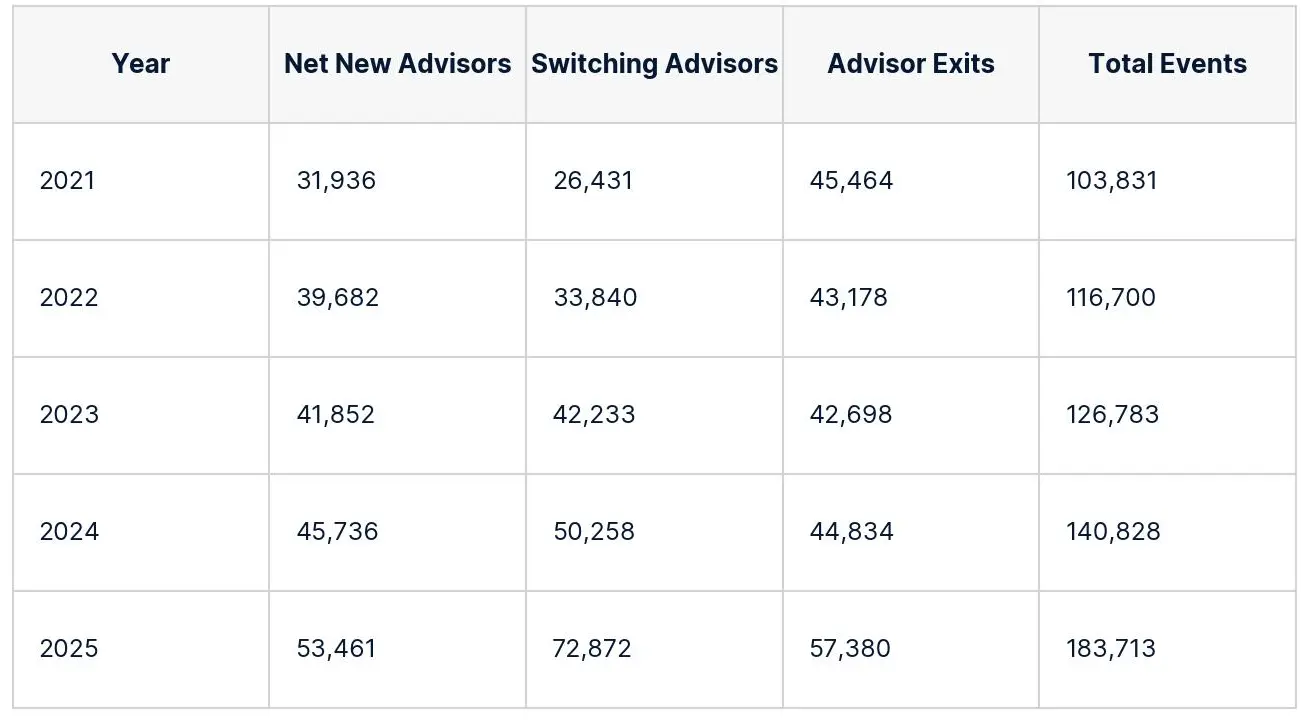
Advisor Movement Trends (2021-2025)
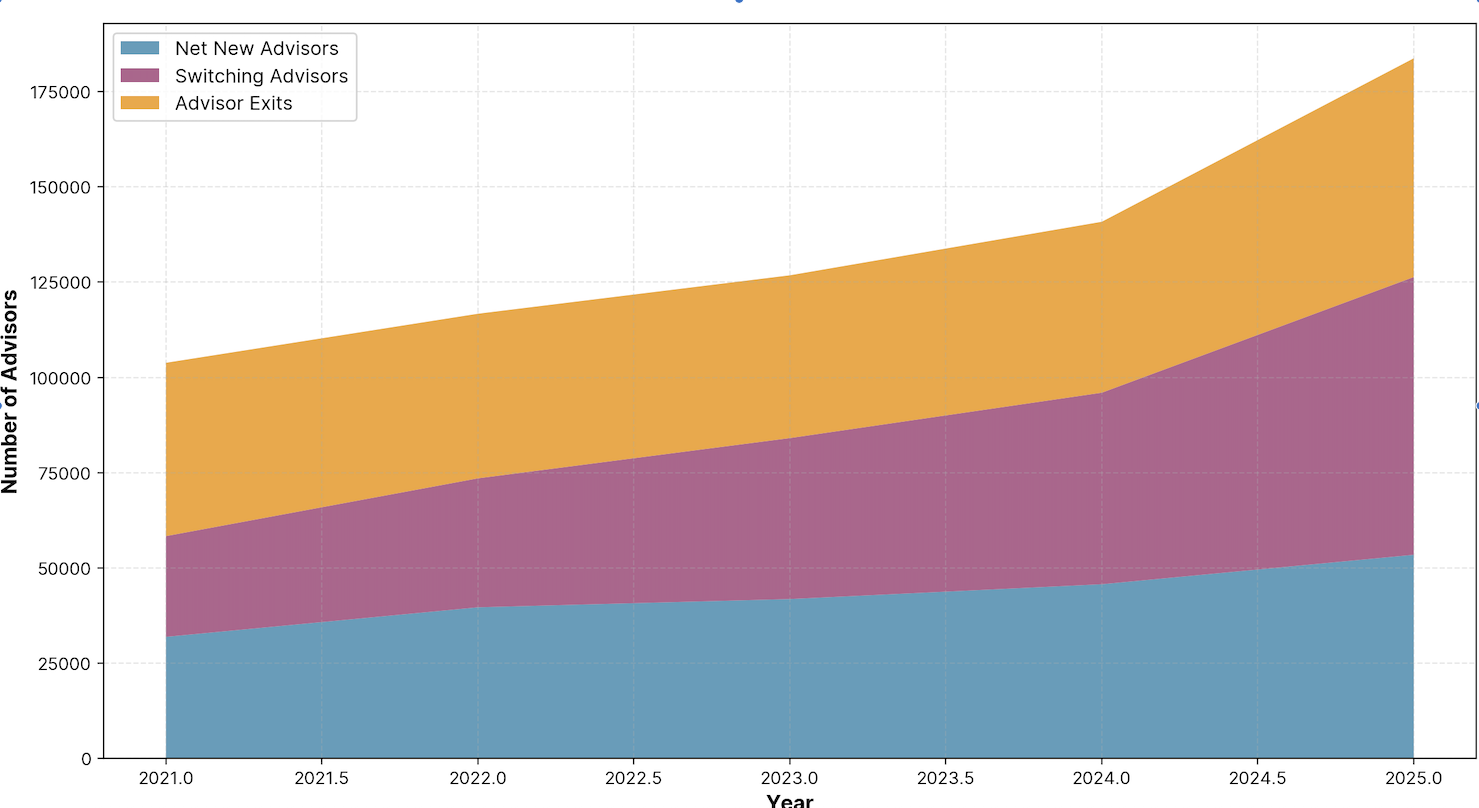
Key observations:
- Total advisor movement events increased by 79,882 from 2021 to 2025, representing a 76.9% increase over the period.
- Switching advisors increased 176% from 2021 to 2025.
- Net new advisors increased 67% over the same period.
- Advisor exits remained comparatively stable, with a sharper increase in 2025.
These trends indicate that overall advisor movement is accelerating primarily through re-platforming rather than workforce expansion.
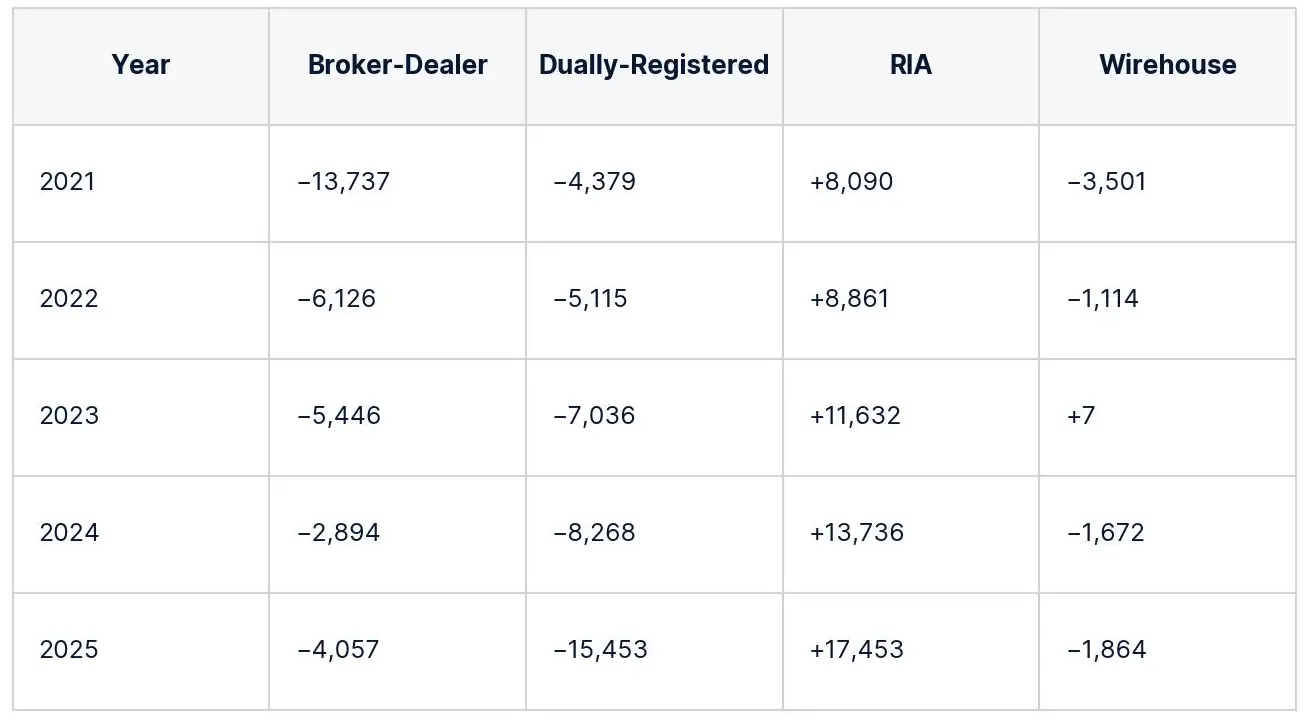
2021-2025 Channel Net Change Trend
3. Advisor Switching Dynamics in 2025
By 2025, switching activity surpassed net new advisor formation as the dominant form of advisor movement. This marks a clear break from earlier periods when industry growth relied more heavily on new advisor entry.
This shift reflects several structural factors:
- A maturing advisor workforce
- Sustained consolidation and M&A activity
- Increased platform optionality
- Lower perceived friction to re-platform
Collectively, these forces have repositioned advisor switching as the primary mechanism through which competitive dynamics play out.
4. Platform Switching Concentration 2025
While advisor switching activity has accelerated sharply, it is not dominated by a small handful of platforms. After normalizing advisor movement to reflect true, advisor-level career decisions - counting each advisor once per year based on their ultimate platform outcome - approximately 69,712 unique advisors switched platforms at least once in 2025.
Switching activity does exhibit moderate concentration among leading platforms, but the distribution remains meaningfully fragmented across the broader marketplace.
Concentration of Platform Switching (2025)
(Advisor-intent & platform normalized)
Platform Switching Concentration
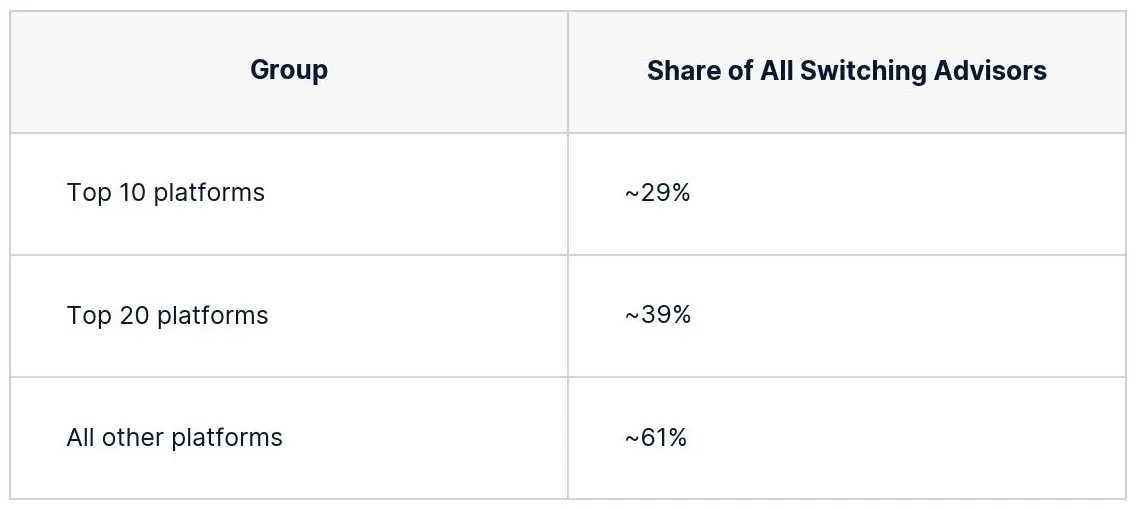
The majority of platform switching activity remains distributed across dozens of firms outside the largest platforms. This indicates a highly competitive recruiting environment, where advisors continue to evaluate a wide range of platform options rather than converging on a single dominant destination.
5. Advisor Channel Transition Patterns (2025)
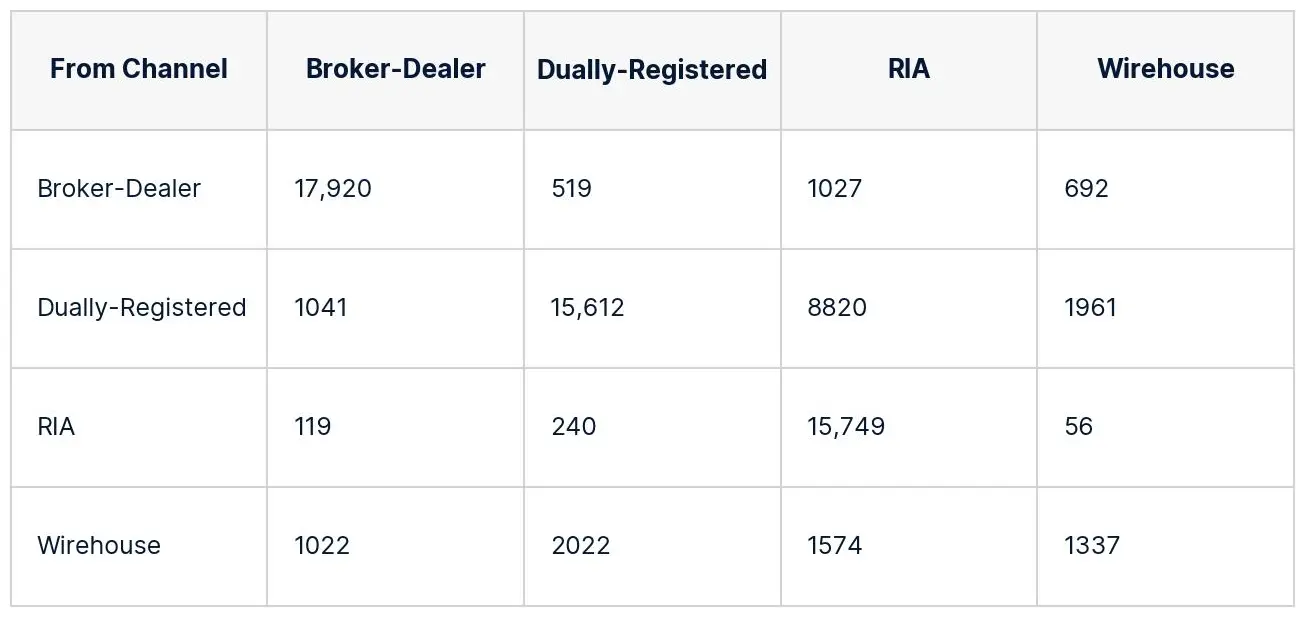
Channel Transition Counts 2025
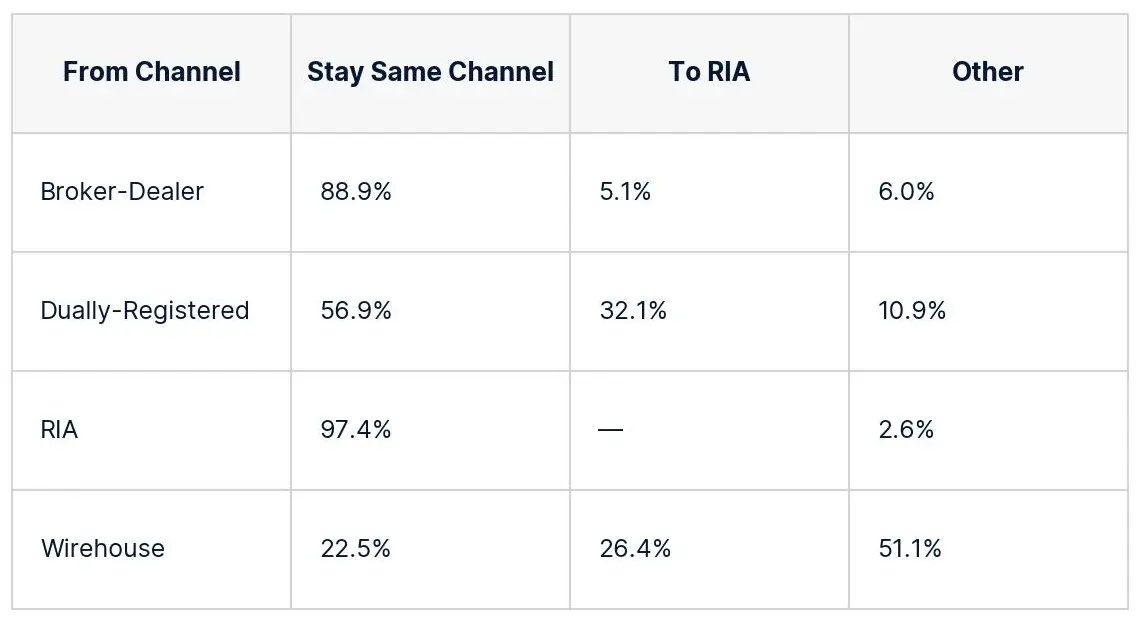
Channel Transition Percentages 2025
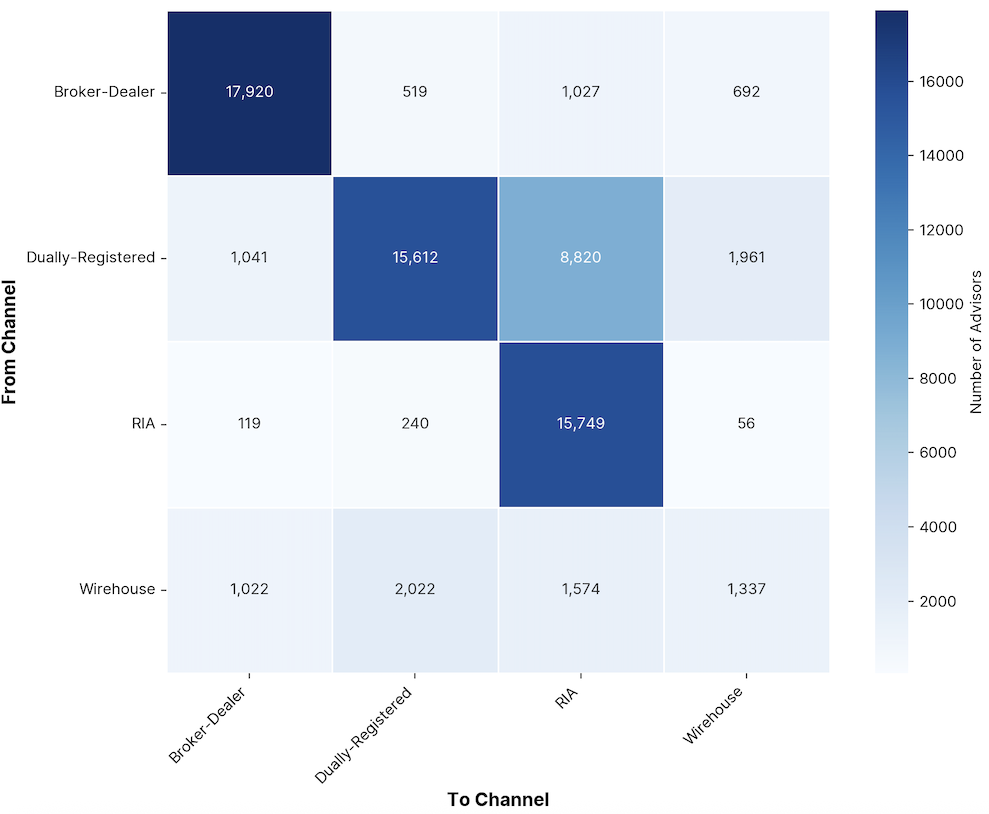
Channel Transition Heatmap: Advisor Migration Paths
Takeaways:
- RIA stickiness remains very high: 97.4% of RIA-origin switchers stayed within the RIA channel.
- Dually-registered remains the largest feeder into RIAs: 32.1% of dual-origin switchers moved into RIA in 2025.
- Wirehouse advisors remain the most cross-channel mobile: only 22.5% stayed within the wirehouse channel, while 26.4% moved into RIA and 51.1% transitioned elsewhere.
6. Net Growth Attribution by Channel (2025)
Structural Net Change by Channel
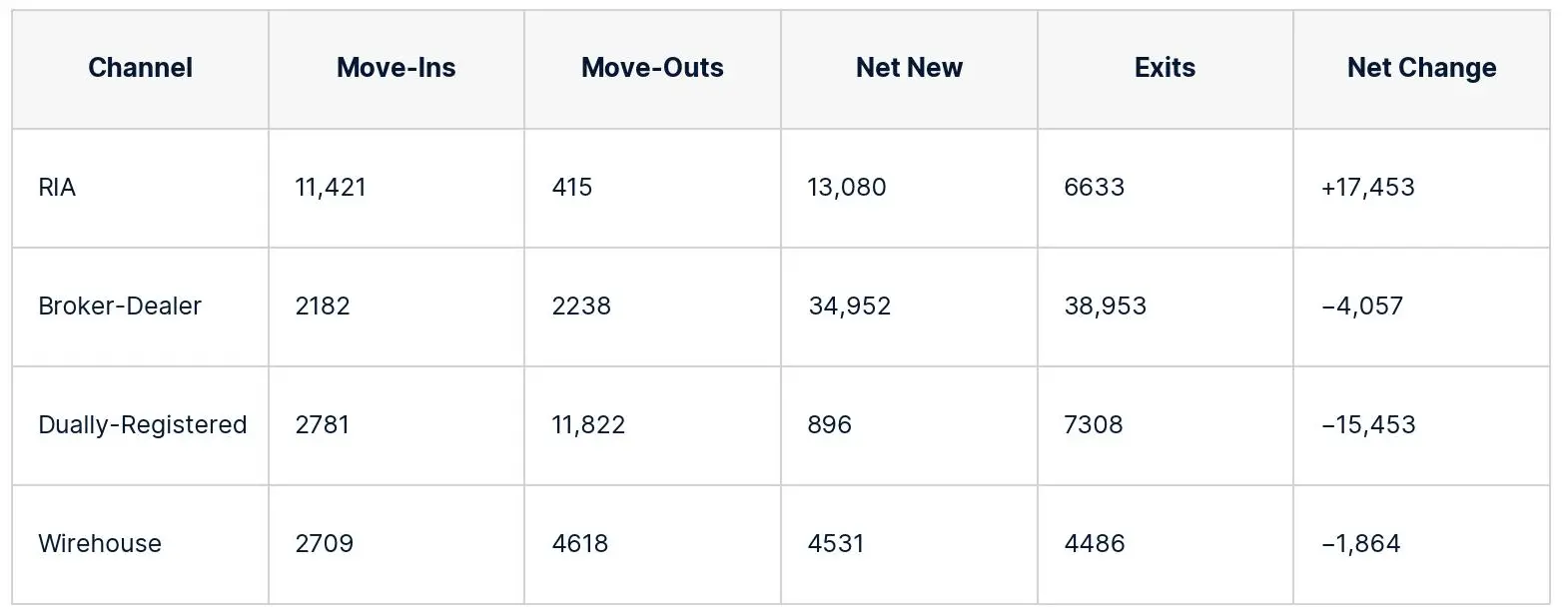
Net Change by Channel
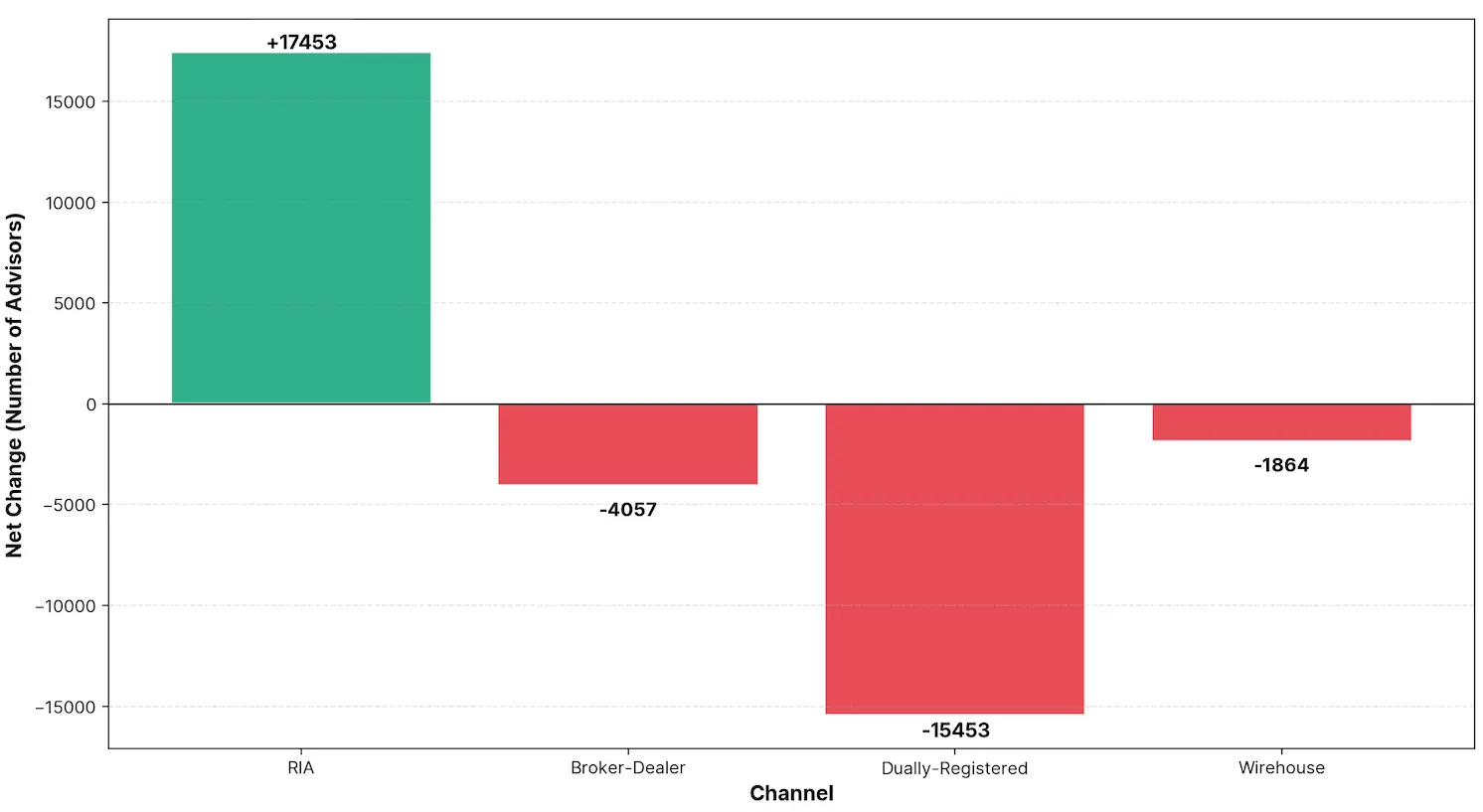
The RIA channel is the only channel demonstrating sustained structural net inflows, reinforcing its role as the primary long-term beneficiary of advisor re-platforming.
7. Top Platforms by Net Advisor Change (Switching-Only, 2025)
Top Platforms by Net Advisor Change (Switching Only)

This table isolates competitive recruiting outcomes and should not be interpreted as total platform growth.
8. Platform-to-Platform Switching Flows: LPL Case Study
Looking at the top 10 sources of advisor inflows to LPL Financial in 2025, approximately 65% of inflows were inorganic (acquisition-driven), while 35% reflected organic competitive advisor switches. This balance becomes more equal further down the source list, indicating both acquisition-driven and organic recruiting strength.
Top 10 Platforms LPL Organically Took Advisors From (2025)
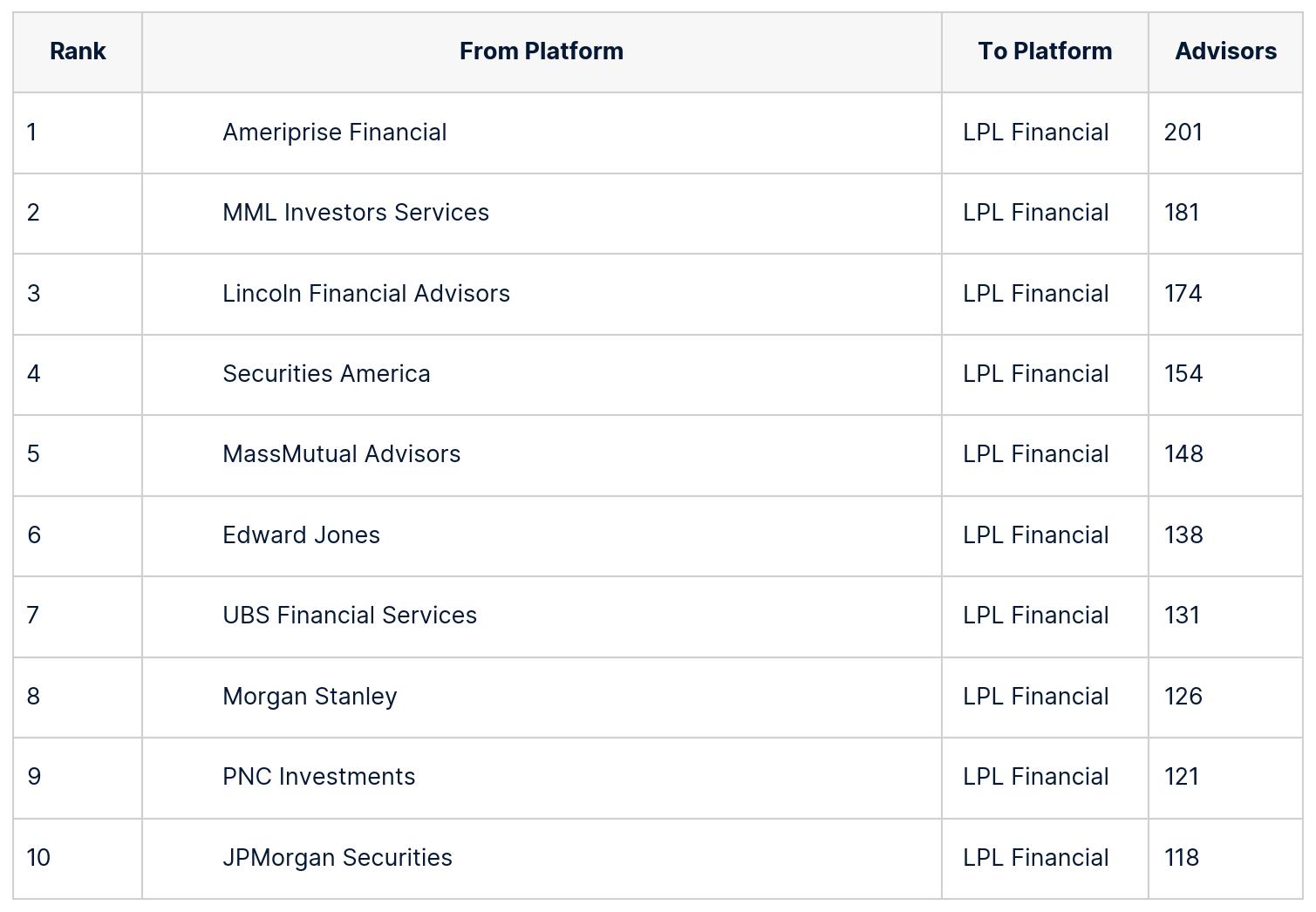
Top 10 Platform Migrations to LPL Financial
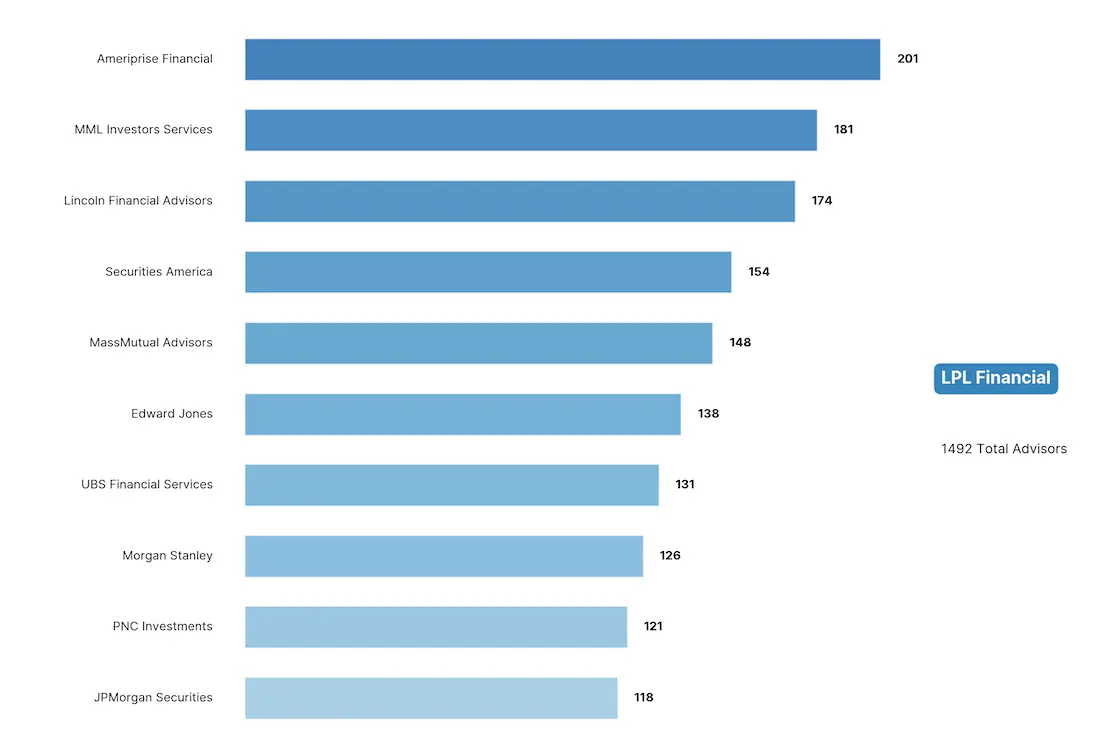
10. Closing Perspective
The wealth management industry is undergoing a re-sorting rather than a reshuffling. Advisors are moving with intent, platforms are competing aggressively, and long-term growth is accruing to firms that align with how advisors want to operate today.
Understanding who moves, where they go, and who retains them is now essential for any firm planning for growth in 2026 and beyond.
To see advisor movement in real time, track platform level shifts, and build smarter lists for recruiting, distribution, or market intelligence, start your free trial.
11. Methodology & Normalization Framework
This analysis examines U.S. advisor movement from 2021 through 2025, normalized at the advisor-intent level to eliminate administrative noise caused by multi-registration, transitional licensing, and platform mechanics.
Key methodology elements include:
- Multiple registrations occurring within a 30-day window and resolving to a single destination firm are treated as one intentional advisor move.
- Related legal entities are consolidated into platform-level groupings that reflect how advisors evaluate career decisions (e.g., Cetera, Osaic).
- Non-competitive internal advisory structures are excluded from firm-level competitive analysis.
- Net growth definition: Net Change = (Switch-Ins + Net New Advisors) − (Switch-Outs + Exits)
This framework ensures each observed event reflects a career outcome rather than a regulatory or operational shuffle.
About AdvizorPro
AdvizorPro is the advisor intelligence platform built for asset managers, ETF issuers, wealthtechs, and distribution teams that need to identify, prioritize, and engage financial advisors. With verified data across 750,000+ RIAs, family offices, and broker-dealers - combined with AI-powered lead scoring, TrafficIQ visitor intelligence, native CRM integrations, and now direct connectivity to Claude and ChatGPT - AdvizorPro powers the go-to-market strategies of leading firms across the wealth management ecosystem.
Want to track advisor movement in real time? Book a quick demo

Cole Cummings is the Director of Marketing at AdvizorPro and a B2B SaaS marketer with multiple years of experience in the fintech industry. He leads all of AdvizorPro’s data-driven research and industry reports, giving him deep expertise in the RIA ecosystem and the trends shaping advisor behavior, allocation decisions, and firm growth across wealth management.
Related Post
Related insights you may find valuable