Selling Into RIAs Isn’t About More Data
.avif)
.avif)
.avif)
It’s About Knowing Who to Call Next
For most asset managers, selling into RIAs doesn’t fail because of a lack of data.
It fails because everything looks equally important.
You have thousands of firms. Trillions in AUM. Endless lists, filters, exports, and spreadsheets. On paper, you have coverage. In reality, your sales team is guessing.
And when every RIA looks like a potential opportunity, the result is predictable:
the wrong conversations, at the wrong time, with the wrong firms. Here's the reality: you might have 10,000 RIAs in your CRM. But only 550 - maybe fewer - are actually in market right now. The question isn't whether you have coverage. It's whether you can identify the 5.5% that matters
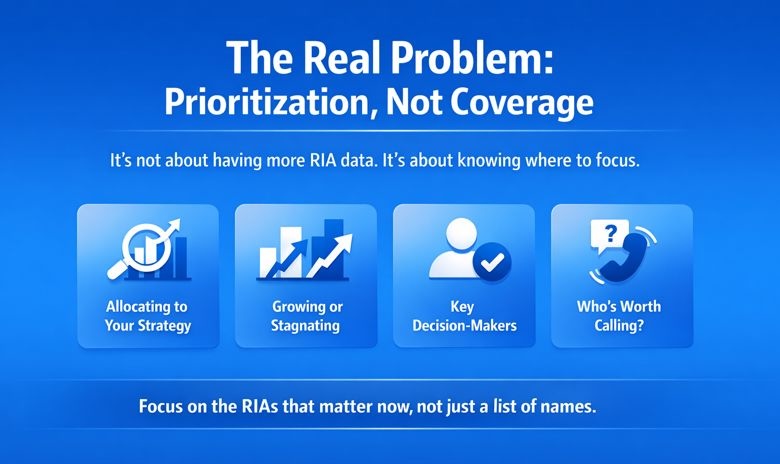
The Real Problem: Prioritization, Not Coverage
Most asset managers don't need more RIA data. If you have 10,000 firms in your CRM, you already have plenty. The problem is that only 550 of them are actually in market right now - and you can't tell which ones they are.
They need to know:
- Which firms are actually allocating to strategies like theirs
- Which RIAs are growing vs. stagnating
- Which decision-makers matter right now
- And most importantly - who is worth calling next
Traditional RIA databases weren’t built to answer those questions. They were built to provide static snapshots: firm name, AUM, address, maybe a contact or two.
In practice, this means sales teams treat a growing, strategy-aligned RIA the same as one that hasn’t changed in years.
That’s not intelligence. That’s a directory.
If you want a deeper breakdown of why this shift matters, see Why You Need a Live Database Instead of a One Time Prospect List.
Why “More Data” Often Makes Things Worse
When sales teams get broad, undifferentiated lists, they fall back on familiar names instead of high-probability targets. High-potential RIAs get buried alongside low-probability prospects. Reps spend hours researching instead of selling.
The irony is that adding more data often increases confusion rather than clarity. Without context, meaningful signals, or clear prioritization, data quickly turns into noise.
RIAs Leave Signals - Most Teams Just Don’t See Them
RIAs don’t randomly allocate capital.
Their behavior leaves patterns:
- Changes in portfolio construction
- Shifts between active, passive, SMA, or alternative strategies
- Hiring activity and firm growth
- Technology and platform adoption
- Product mix evolution over time
If you want a concrete example of how allocation behavior shows up in the data, see the RIA ETF Trends Report Q3 2025.
Hiring and movement signals can be just as telling, especially when leadership changes or teams break away. For a broader view, see the Advisor Movement Trends Report 2025.
When surfaced correctly, these signals tell sales teams who is entering a buying window - not just who exists. These signals matter far more than firm size alone. A $500M RIA showing new strategy adoption is often a better opportunity than a $5B firm standing still.
But most sales teams can’t see these signals clearly - or at all.
In many cases, some of the strongest intent signals are already in your digital funnel. For an example of how teams turn that into targeting, see How Asset Managers Can Identify RIAs Visiting Their Website.
Knowing Who to Call Next Changes Everything
When asset managers shift from coverage-based selling to signal-based prioritization, the entire motion changes. Reps focus on firms already aligned with their strategy.
Conversations start with relevance instead of cold education. Pipelines become more predictable. And win rates improve, even with fewer total meetings.
Instead of asking, “Who should I call today?”
sales teams start asking, “Which RIAs are most likely to allocate next?”
That’s the difference between activity and effectiveness.
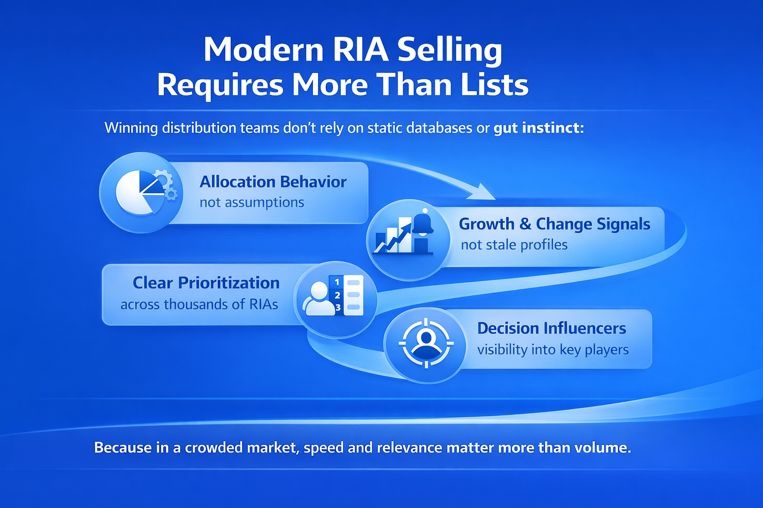
Modern RIA Selling Requires More Than Lists
Winning distribution teams don’t rely on static databases or gut instinct.
They rely on:
- Allocation behavior, not assumptions
- Growth and change signals, not stale profiles
- Clear prioritization across thousands of RIAs
- Visibility into who actually influences decisions
Because in a crowded market, speed and relevance matter more than volume.
The Bottom Line
Selling into RIAs isn’t about collecting more data points.
It’s about turning the data you already have into actionable direction - so your team knows exactly who to call, when to call them, and why that conversation matters.
The firms that get this right don’t just work harder.
They work smarter - and they win more often.
Start your free trial to access real time RIA intelligence and prioritize the firms most likely to allocate next.

Cole Cummings is the Director of Marketing at AdvizorPro and a B2B SaaS marketer with multiple years of experience in the fintech industry. He leads all of AdvizorPro’s data-driven research and industry reports, giving him deep expertise in the RIA ecosystem and the trends shaping advisor behavior, allocation decisions, and firm growth across wealth management.
Related Post
Related insights you may find valuable