Largest Independent Broker-Dealers: How To Compare Firms
.avif)
.avif)
.avif)
If you're an asset manager, wealthtech company, or recruiter, knowing which independent broker-dealers operate at the largest scale matters. It shapes where you focus your distribution efforts, which partnerships make sense to pursue, and where the best advisor recruiting opportunities exist.
But size in the independent broker-dealer world isn't straightforward. Unlike other parts of the market, there's no single number that tells the whole story. Depending on what you're trying to accomplish, scale might mean the number of advisors on the platform, total assets under administration, how many firms operate under the same network, or how broadly a firm's technology reaches across the industry. Context matters, and using the wrong measure can send you chasing the wrong firms.
What Qualifies as an Independent Broker-Dealer?
Independent broker-dealers operate outside of wirehouse and bank-affiliated models, offering advisors greater autonomy over business ownership, client relationships, and practice structure. While business models vary, independent broker-dealers typically share several characteristics:
- Advisors operate as independent contractors or through OSJ structures
- The firm provides compliance, supervision, clearing, and platform support
- Advisors retain flexibility around investment approach, branding, and client engagement
- Many support hybrid models, including affiliated RIAs
Independence matters because it shapes advisor mobility, platform economics, and how third parties engage with the network, particularly at scale.
What Does “Largest” Mean for Independent Broker-Dealers?
In the broker-dealer market, “largest” depends on the lens being applied. Common measures of scale include:
- Registered representative count: Often the most cited metric, but not always reflective of production or engagement
- Revenue scale and advisor productivity: Indicates economic strength but is less consistently disclosed
- Geographic footprint and OSJ network size: Signals distribution reach and operational complexity
- Clearing and platform relationships: Reflects infrastructure scale and integration depth
No single metric provides a complete picture. The largest independent broker-dealers tend to rank highly across multiple dimensions rather than dominating just one.
The Largest IBDs in 2026
This interactive table ranks the top 100 largest IBDs with more than 2,000 B-D Reps.
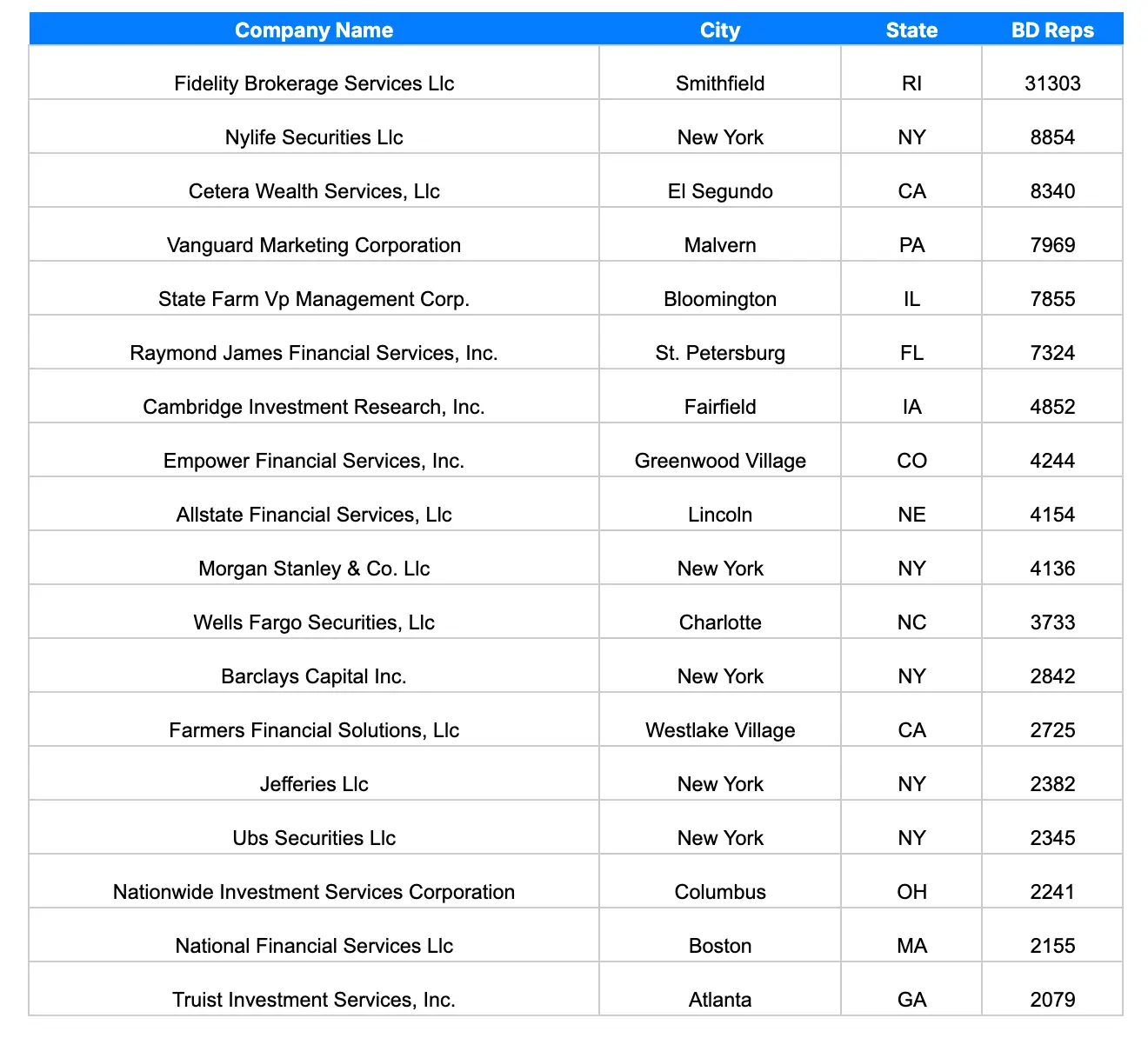
Why Broker-Dealer Size Is Harder To Measure Than RIA Size
Compared to the top RIAs, broker-dealer scale is more difficult to normalize due to structural and reporting differences:
- Multiple data sources: FINRA disclosures, firm filings, and third-party datasets vary in scope and refresh cadence
- Rep counts vs. active producers: Headcount does not always reflect production or engagement levels
- Hybrid and OSJ structures: Assets, advisors, and revenue may sit across multiple legal entities
- AUA vs. advisory AUM: Broker-dealer assets often include brokerage, advisory, and retirement assets reported differently
- Lagging or inconsistent updates: Organizational change can take time to surface in public data
As a result, understanding scale requires looking beyond static numbers and toward patterns of change.
Growth Signals That Indicate a Large or Scaling Independent Broker-Dealer
While headline size metrics matter, growth signals often provide better insight into where momentum exists. Indicators commonly associated with large or expanding independent broker-dealers include:
- Sustained net advisor growth, not just gross recruiting
- Expansion or consolidation within OSJ networks
- Increasing emphasis on fee-based advisory business
- Investment in platform standardization and advisor technology
- Changes in clearing, custody, or supervision structures
Tracked over time, these signals help distinguish between mature, steady-state platforms and firms actively investing in scale.
How Go-To-Market Teams Evaluate Large Independent Broker-Dealers
Scale in the independent broker-dealer market carries different implications depending on who is evaluating it. The same platform can represent efficient distribution for one audience, significant integration complexity for another, or a concentrated source of recruiting opportunity for a third. Understanding how scale is interpreted across functions helps clarify where and how large independent broker-dealers create value.
Asset Managers
Large independent broker-dealers shape access to distribution through platform structure, advisor mix, and approval processes. Scale influences coverage efficiency, shelf strategy, and product adoption velocity.
Wealthtech Firms
For technology providers, scale introduces complexity. Large broker-dealers often require enterprise alignment, deep integrations, and long-term platform fit, particularly when OSJ-level autonomy exists.
Recruiters
Recruiting opportunity tends to cluster where scale intersects with transition: advisor movement, succession planning, platform change, or hybrid expansion. Large networks often reveal these signals before they are widely visible.
Using Data To Monitor the Independent Broker-Dealer Landscape
Given the structural complexity of the broker-dealer market, identifying the largest and most relevant platforms requires more than periodic research.
Effective monitoring combines:
- Firm-level broker-dealer data and historical changes
- Visibility into affiliated advisors and hybrid relationships
- Trend analysis across recruiting, structure, and platform evolution
For teams that need broker-dealer intelligence embedded directly into internal workflows, programmatic access via structured data feeds and APIs can support deeper analysis, integration with CRM systems, and ongoing market monitoring at scale.
Key Takeaways on the Largest Independent Broker-Dealers
In the independent broker-dealer market, “largest” is not a single number. Rather, it is a function of structure, scale, and momentum. The most influential platforms combine advisor reach, operational depth, and strategic investment, while the most attractive opportunities often emerge where growth signals appear early.
As the market continues to evolve, advantage increasingly comes from identifying which broker-dealers are changing and understanding what those changes signal before they are obvious to everyone else.
About AdvizorPro
AdvizorPro is the advisor intelligence platform built for asset managers, ETF issuers, wealthtechs, and distribution teams that need to identify, prioritize, and engage financial advisors. With verified data across 750,000+ RIAs, family offices, and broker-dealers - combined with AI-powered lead scoring, TrafficIQ visitor intelligence, native CRM integrations, and now direct connectivity to Claude and ChatGPT - AdvizorPro powers the go-to-market strategies of leading firms across the wealth management ecosystem.
Ready to accelerate your advisor distribution strategy? Book a quick demo.

Written by: Cole Cummings
Cole Cummings is the Director of Marketing at AdvizorPro and a B2B SaaS marketer with multiple years of experience in the fintech industry. He leads all of AdvizorPro’s data-driven research and industry reports, giving him deep expertise in the RIA ecosystem and the trends shaping advisor behavior, allocation decisions, and firm growth across wealth management.
Related Post
Related insights you may find valuable

%20(1).webp)