69,000+ Advisors Changed Firms in 2025, Spread Across the Market
.avif)
.avif)
.avif)
Advisor switching activity accelerated sharply in 2025, but the data shows that movement remains broadly distributed rather than concentrated among a small group of dominant platforms. This analysis builds on findings from the broader US Wealth Advisor Movement Report, which examines advisor mobility trends across firms and platforms.
After normalizing advisor movement to reflect true advisor level career decisions, counting each advisor once per year based on their ultimate platform destination, approximately 69,712 unique advisors switched platforms at least once in 2025.
Despite elevated activity, switching behavior does not point to winner take all dynamics. However, it does point to something equally important: an increasingly competitive fight for talent across the entire RIA and broker dealer landscape.
Platform Switching Remains Moderately Concentrated
When viewed through a concentration lens, the largest platforms captured only a portion of overall switching activity.
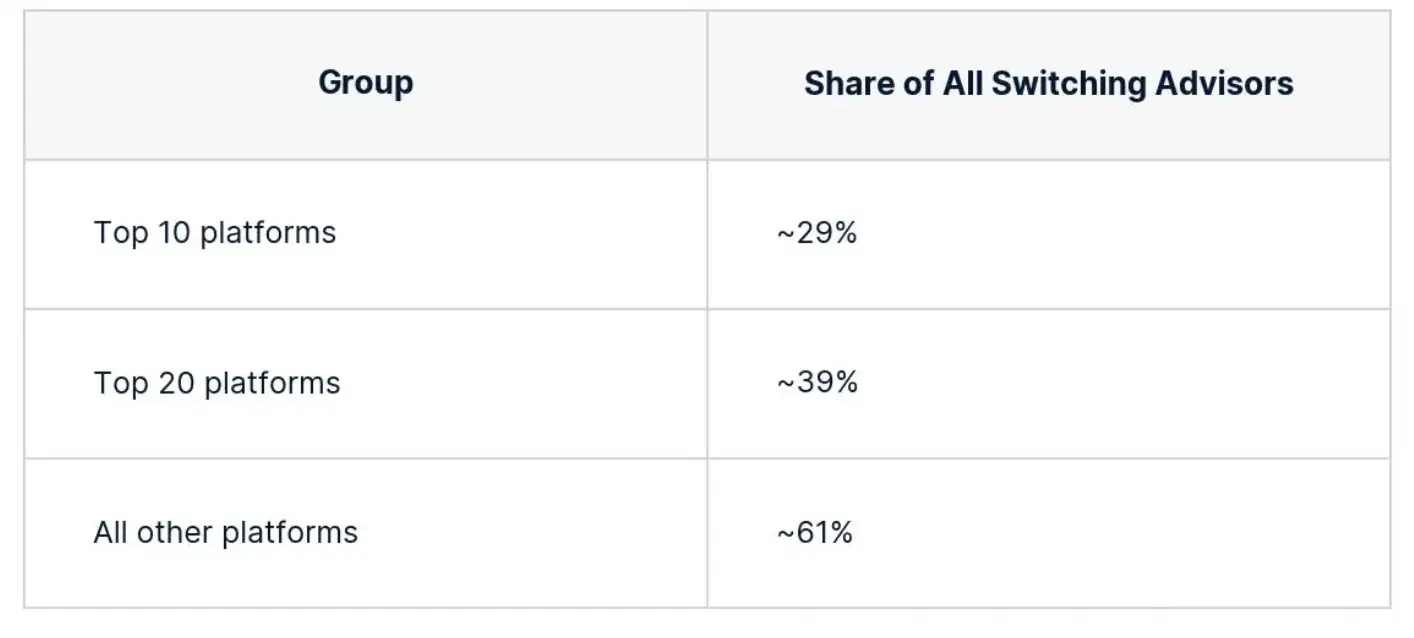
The top 10 platforms accounted for a significant 29 percent of all switching advisors. Expanding the view to the top 20 platforms increases that share to approximately 39 percent. The remaining 61 percent of switching advisors moved to platforms outside the top 20.
This distribution highlights a key structural feature of the advisor market. Even as switching volume rises, advisors continue to evaluate a wide range of platform options rather than converging on a narrow set of destinations. Similar dispersion patterns appear in recent monthly movement snapshots such as Advisor Moves January 2026.
At the same time, competition among the largest platforms has intensified. Throughout 2025, the industry saw aggressive recruiting headlines, including high profile transitions from firms such as Commonwealth Financial Network. These public recruiting battles underscore a broader reality: retaining and attracting the right advisors is central to platform growth and long term valuation
What This Tells Us About Advisor Decision Making
Advisors appear to be making highly contextual decisions based on factors such as payout structure, operational support, independence options, ownership models, and long term growth flexibility. This behavior favors a competitive landscape where regional firms, independents, and specialized platforms continue to attract meaningful advisor interest alongside national players.
Rather than signaling consolidation of advisor movement, the data points to sustained fragmentation and choice. In practical terms, that fragmentation means platforms must compete on substance. Talent is not passively flowing to the largest brands. It is being actively won through differentiated value propositions, transition support, and economic alignment.
Implications for Recruiting and Platform Strategy
For recruiters and platform executives, this fragmentation has important implications.
Recruiting success is unlikely to come from relying on brand strength alone. Platforms that can clearly articulate differentiated value propositions, tailored transition support, and advisor aligned economics are better positioned to compete for talent in a crowded marketplace.
For asset managers, wealth technology providers, and service firms, this dispersion reinforces the need for broad coverage and precise targeting. Advisors are moving across dozens of platforms, creating ongoing changes in distribution access and relationship ownership.
An Intensifying Fight for Advisor Talent
The 2025 switching data reinforces that advisor mobility is both active and competitive. Growth opportunities are spread across the ecosystem, not concentrated in a small handful of firms.
Understanding where advisors are moving, why they are switching, and how platform dynamics are evolving requires more than headline rankings. It requires normalized movement data, historical context, and the ability to track trends as they unfold.
AdvizorPro continuously tracks advisor platform switching, ownership changes, and firm level dynamics across the wealth management industry. To explore deeper insights into advisor movement patterns and what they signal for recruiting and distribution strategy, start your free trial.

Cole Cummings is the Director of Marketing at AdvizorPro and a B2B SaaS marketer with multiple years of experience in the fintech industry. He leads all of AdvizorPro’s data-driven research and industry reports, giving him deep expertise in the RIA ecosystem and the trends shaping advisor behavior, allocation decisions, and firm growth across wealth management.
Related Post
Related insights you may find valuable